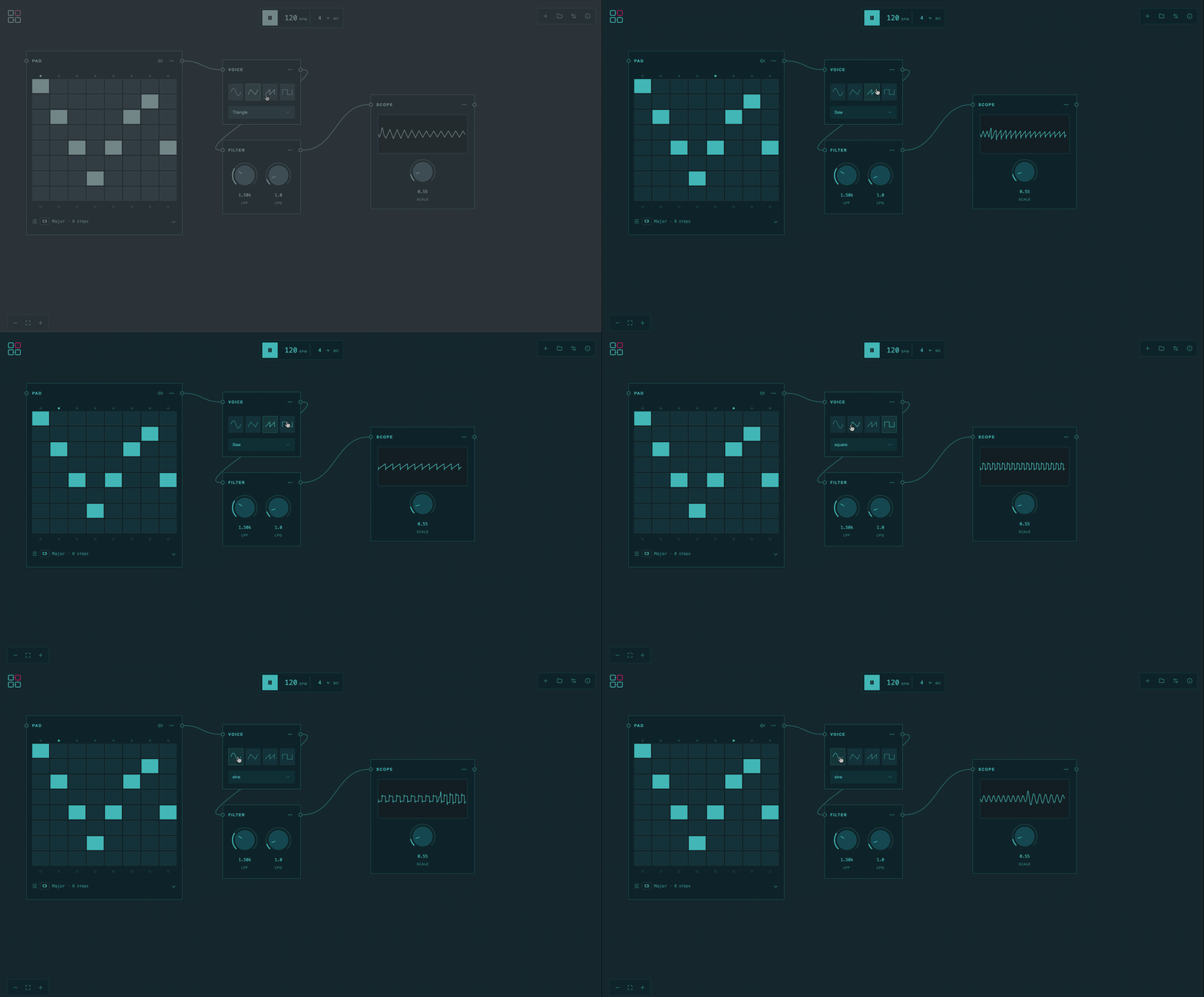
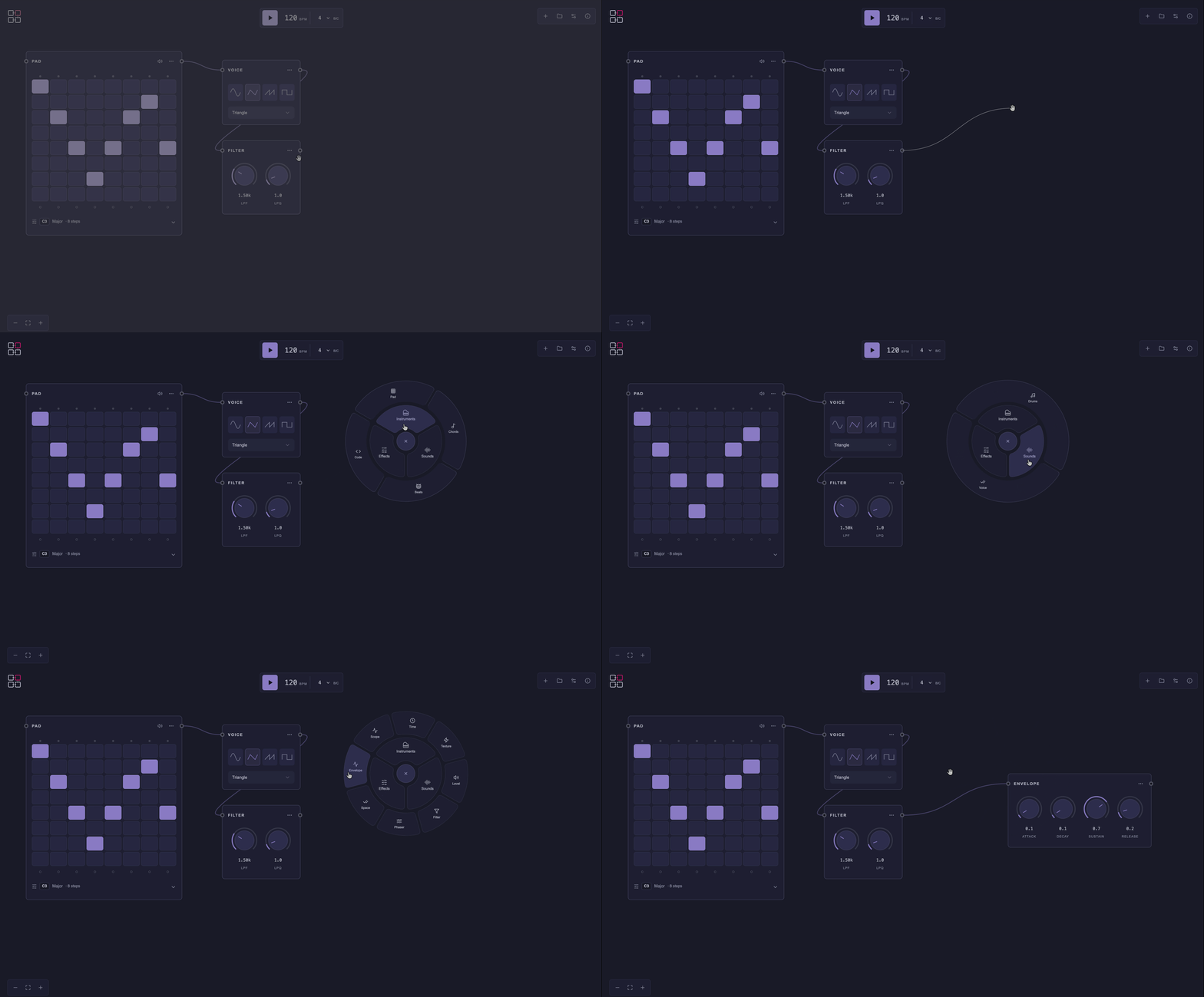
I don't talk about work much on here, but I work in open-source software, and we just released Strudel Flow 2, a new version of our visual music sequencer built with React Flow and Strudel. Version 1 came out last year, and I've been tinkering around with these updates all summer. If you're curious, you can find the code on GitHub.
AI is taking our jobs, and where's the fun in that? As many of you know, I've had a rough year and been a little distracted at work. Almost imperceptibly, while I was distracted, the entire world changed. Over the last 10 months, we've stopped getting emails from people asking for technical support on our projects. Our Discord channels, which, to be fair, were never particularly chatty, have gone silent. Our subscriptions, which we rely on to maintain the libraries, have been slowly but steadily decreasing, as have our website views.
What hasn't decreased, however, is the number of applications using our software. By our estimates, approximately 8% of projects using React on the web use React Flow. That's staggering because React is one of the most popular libraries for building interfaces on the web. And these numbers grow every day.
I hadn't realized how much the world had changed until I was sitting on a sofa in a Berlin club with a group of software developers who told me none of them ever open their IDE anymore (for the non-technical, that's the application you use to write code), and I was snapped back into reality. The robots do our work for us now.
What this means for open source is confusing. At work, we've written about this a few times. We are one of the few large open-source projects with a self-sustaining financial model. Historically, this was due to our open-core model. Our libraries are free for anyone to use, even large corporations. For personalized support and complicated examples, we ask for a little money to help keep the lights on. Back in ancient history, when humans still wrote code, this worked for us, because humans had questions that robots don't, but now the future is looking a bit murky.
Before you ask, yes, this is something that you should personally be worried about. I admit I'm not the greatest spokesperson because I treat my 3-day-a-week job with the blasé attitude of someone who truly has nothing to lose, but I would like to refer you to a famous software meme:
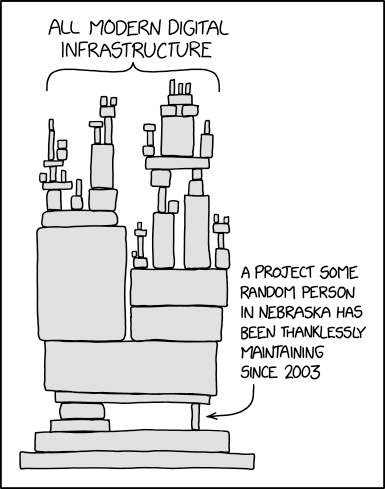
The online world is scaffolded by free software that somebody needs to maintain. I was told recently that it would cost $8.8 trillion for companies to replace the open-source software they rely on. It's a huge and incredibly fragile system, being made more fragile every day, and every day more interesting horror stories come out.
In 2024, a programmer almost managed to slip a backdoor into a widely used open-source project by offering to help with small tasks until the head maintainer let his guard down. Increasingly, AI scans entire repositories for vulnerabilities, something it's very good at, because developers previously looking for these mistakes were only human. Corporations are rightly scared. It’s become enough of a problem that GitHub recently paid us to look into the security of our own software.
I would find all of this easier to complain about if I weren't also benefiting from it. The phrase I hear thrown around a lot when people talk about AI is "cognitive dissonance". I use AI at work. In low moments, I even ask it questions about my personal life. The success of the UI I build for free is precisely because AI has become so popular. The flowchart is the de facto no-code user interface for engaging with AI models, and our success would not be possible without the popularity of AI.
There would be no escaping this dissonance, though, no matter what kind of software I built. I went to a conference in the summer about data-protection within the software world, the thesis being that keeping your files on your computer lets you retain ownership of your work. I sat in the back of the auditorium, and through a sea of open laptops, I listened as people groaned whenever the word AI came up, while simultaneously looking at everyone's computer open to the latest AI agent.
The annoying thing is that I still love coding. I can feel completely powerless in life, and then I can just make something, for free, whatever it is I want. As much as I want to throw the whole thing in the trash, an emotionally moving kernel still exists within software development, and I don't think it will ever disappear.
Strudel Flow is one of the things I work on when I need to remember why I like doing this. Strudel itself is a live-coding language for music, meaning you can write code in your browser and hear the music change as you write it. Our app builds on that idea with a visual interface, where each node creates or transforms Strudel code. You can see and hear what you're making, and take the generated code to keep experimenting elsewhere. In the new version, we've added ways for people to share their patches and create their own instruments and effects.
The manifesto written by the makers of Strudel in a smoky bar in Hamburg in 2004 gives us some insight into why coding is still worth doing, even when it can be done for us. The ethos of the movement is to code in public, to show your process, and to let people see and hear the changes as they happen, mistakes included, because algorithms are thoughts. They are insights into the human mind. Programming, like writing, is a display of mental and physical dexterity. Even if my career is fucked, I love open source because an algorithm deserves to be seen by everyone, even if it's a really bad one that I made, because the program is meant to be transcended.
One bug catcher on the internet who recently spotted an error in GPS data handling that required systems across the world to be updated found it because writing software was, according to him, "more fun than sudoku".