The Berlin Conference
I've been spamming a lot of raffle contests lately on Instagram, trying to win free stuff, which is how, by way of a very generous DM, I was offered a press pass to the design conference FORM/FUTURE a few months ago. The very generous DM dissolved almost as soon as I received it – she may have finally read my blog – and the press pass never came through, but I was determined to go anyway and ended up scoring a free ticket through a friend at my old coworking space, who I had once given five minutes of free advice to about WordPress.
The conference was held at the ICC – not that ICC – but the Berlin Internationales Congress Centrum, a stunning example of post-war German architecture opened in 1979. Visually, the ICC is like the most beautiful, ugly airport you've ever seen. There were ashtrays next to the toilet paper. The carpeted floors were stained. It smelled like a dorm room, which overwhelmed those of us there to discuss the future. It has been closed since 2014 due to asbestos contamination, the removal of which has not yet taken place. A true lady, I was overwhelmed by the amount of vacuuming required to keep the building tidy, which had presumably not been done in recent years to prevent unwanted micro-particles from stirring up.
After a summer and fall spent traversing the globe to hear what our best and brightest are thinking, it is my personal belief that conferencing should be outlawed in general. Having attended several conferences in Berlin over the past few years—and leaving each time with my mouth agape in pure horror—it all begins to make sense how so many historic things could have happened. The city has already hosted a few famously failed attempts to improve society by gathering people in a room: the Berlin Conference, the Potsdam Conference, and the Wannsee Conference, to name a few. It’s a cheap joke, but perhaps these should have been enough to faithfully conclude that society has improved enough, and that we should go no further! Still, as long as “progress” remains the topic of discussion, it is my duty to don the mantle of the Hannah Arendt of free events in Berlin: to grab a Cuccis coffee at the train station, ride the S-Bahn to the former West Berlin on my Friday off, and be reminded by a moderator that “it’s impossible to design if you don’t believe in the future.”
While, to me, the ideas of these grey-haired geriatric speakers with thick-rimmed glasses, and a sophisticated, modern takes on the traditional pantsuit gave credence to the belief touted by some American fascists that the university has outlasted it's usefulness, and that we we should abolish it and assign everyone to hard manual labor instead, Prof. Birgit Mager, in her keynote talk, dared instead to ask the question, "What if women could make money not just for prostitution, but also baking cakes?"
Prof. Mager was hired by the city of Eindhoven to use design to deal with their problem of "drug addicted street prostitution" (her words, not mine). Eindhoven has already invested €500,000/year to move all sex workers outside of the city center to a series of shipping containers called the Tippelzone. This improved residents' quality of life in the inner city, but it didn't address the women living in the shipping containers. Design is a practice of problem-solving through incremental trial and error, so Prof. Mager worked with the Design University of Eindhoven on a series of provocative exhibitions to highlight and improve the women's lives. What if the women could earn non-monetary credits for good deeds, like doing laundry, she asked. Together with her students, they produced a series of provocations, including an "exhibition of women prostituting themselves in the maze of a corn field". For this, they "designed costumes for the prostitutes so they would be seen in the dark".
In a talk titled "Design and Disaster", Prof. Regina Hanke brought three designers on stage for a round table discussion. She said she is fortunate that she is not too familiar with disasters; the only ones she experienced were personal disasters within her family, and two IRA bombings in London. The others were not so lucky. One Spanish designer said, while responding to the flooding last year in Valencia, that "the design community was ready to react". After the disaster, they sent a message to their community by email asking, "Do you need help?" They realized a week later that most people who needed help would be unable to access email. If not email, how were they able to contact citizens, one audience member asked? "It was tricky".
Halla Helgadottir of Iceland was not always a designer. "I was working in a fish factory", she says. Regarding disasters, "We have been in a luxurious position in Iceland with not many people dying." She imagines a city in Iceland being built naturally, entirely of lava, with lava forming the houses and roads. There isn't much danger in nature in Iceland, aside from the volcanoes, she says. "We are not hierarchical."
Mehmet Kalyoncu, a Turkish "architect, businessperson, NGO volunteer, entrepreneur and composer, "was assisting in the design of the reconstruction of the entire Turkish city of Hatay after the devastating 2023 earthquakes that took over 50,000 lives. Of the design, he says, "When disaster happens, our role in society changes."
I felt some red flags from Kalyoncu after hearing him introduced as a "composer." A quick five-minute Google search revealed his father is the owner of Kalyon Group, a construction and media conglomerate, part of President Erdoğan's infamous "gang of five" — a collection of five corporations that effectively dominate all major public infrastructure projects in Turkey. These companies have also been accused of pooling resources to finance pro-government media. Essentially, only five major firms in the country control the bulk of state contracts, and Mehmet's father owns one of them. Erdoğan was even at Kalyoncu Jr's wedding.
In Hatay, where Kalyoncu’s design project was carried out, an indictment cited extensive regulatory failures related to buildings that collapsed in the earthquake. According to the indictment, structures constructed before the quake lacked proper building permits, static project documentation, accounting reports, and ground survey data. An expert report included in the case further identified serious construction defects, including the use of non-ribbed reinforcement steel, poorly executed iron reinforcement, and irregular stirrup placement in columns and beams.
Following the earthquake, the government faced public criticism for protecting a contractor whose luxury buildings collapsed and who was reportedly detained while attempting to flee the country. More recently, 70 workers in the reconstruction were dismissed after they objected to unlawful construction practices in the earthquake zone. The workers alleged that management had instructed them to use only half of the legally required amount of reinforced steel. These may be some of the legal and political impediments to good design that Mehmet mentioned in his talk, while the other designers looked on with barely concealed jealously about the scale of his project.
Jeff Chia from Singapore joined us online via Zoom to ask, “Can a nation be designed?” Singapore, described by its founding prime minister Lee Kuan Yew as “Israel in a Malay-Muslim sea,” is a small, highly planned state whose survival—like Israel’s—depended on strategy, innovation, and careful design. In celebration of its 60th year of independence, the country launched a project to highlight some of its most influential and successful design projects, pointing to the Jewel Changi Airport as its crowning example.
Safdie Architects describe the Jewel as “a unique blend between an intense marketplace and a magical garden of calmness and tranquility.” Shopping at Jewel, they argue, is no longer about fulfilling a single need; instead, it is a full sensory experience. Chia emphasized that architecture has the potential to inspire transformation, calling Jewel a clear example of design’s ability to revolutionize everyday life.
And revolutionize life it has. As the day droned on and the ideas I heard became more meandering: a high-rise that looked like a tree, a pamphlet for Swedes escaping nuclear bombs, a project to grant legal personhood to rivers and other natural elements – "now nature can be a board member", a bizarre obsession with developing interspecies communication, plastered on all the walls around me:
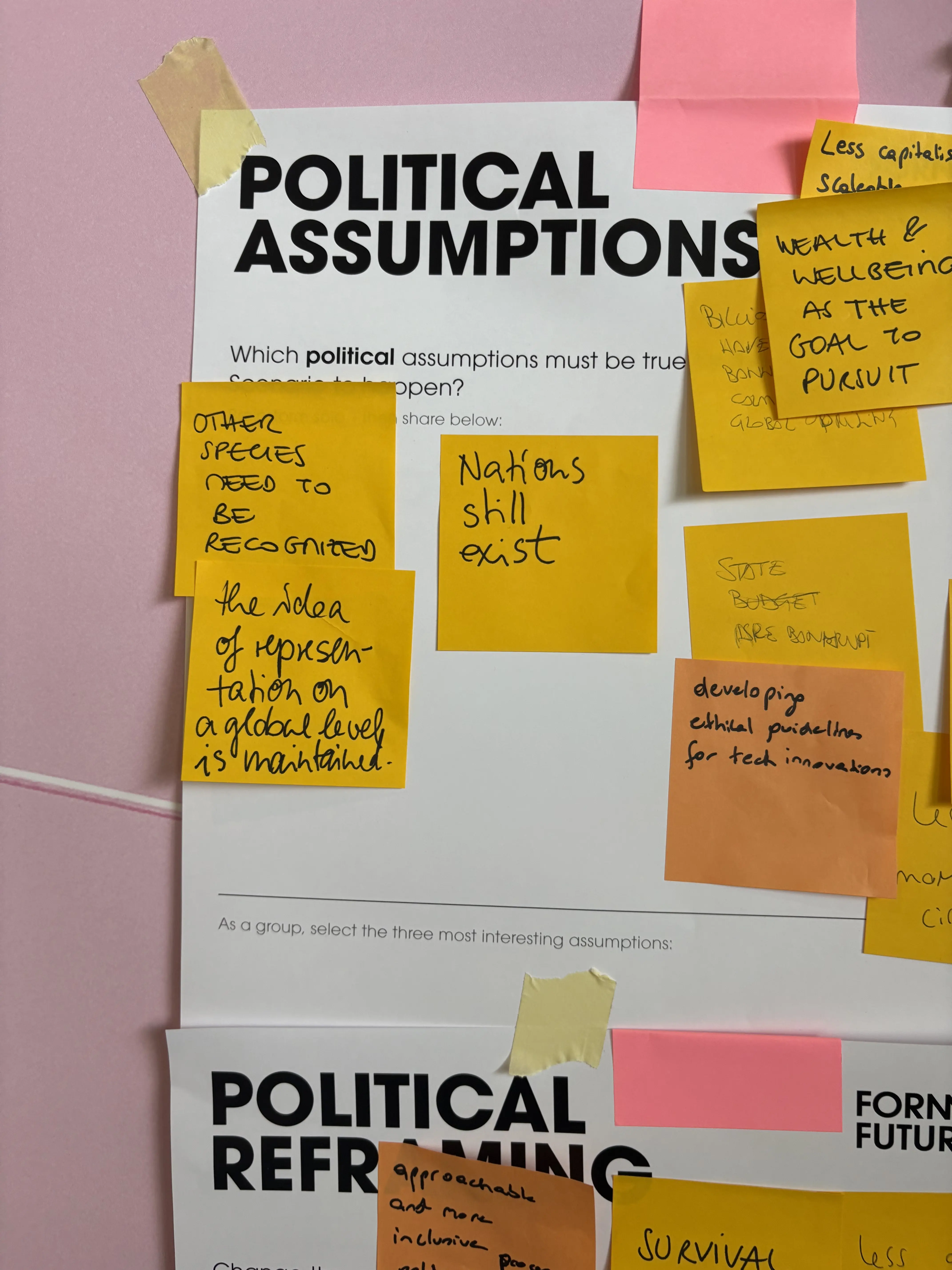
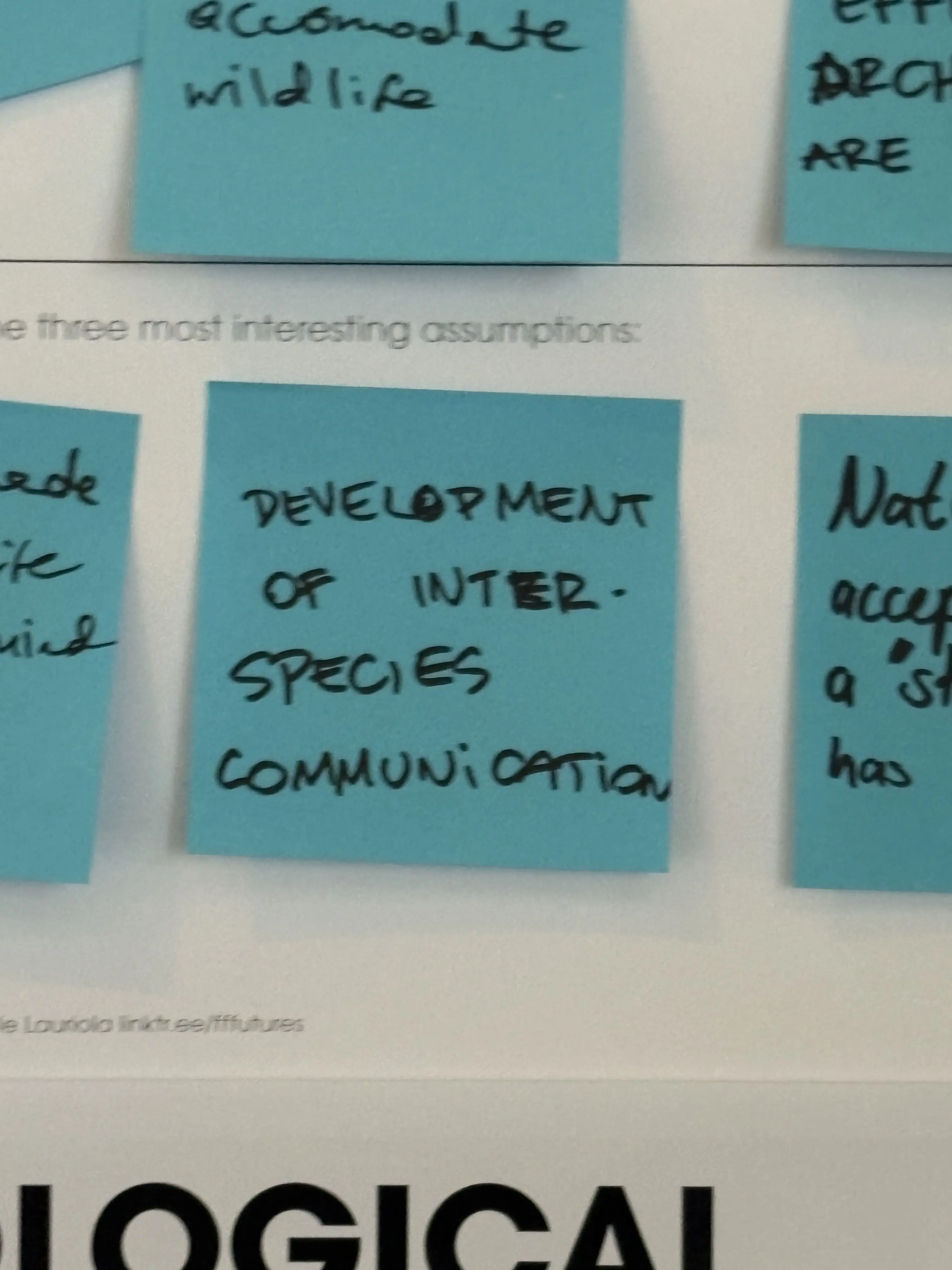
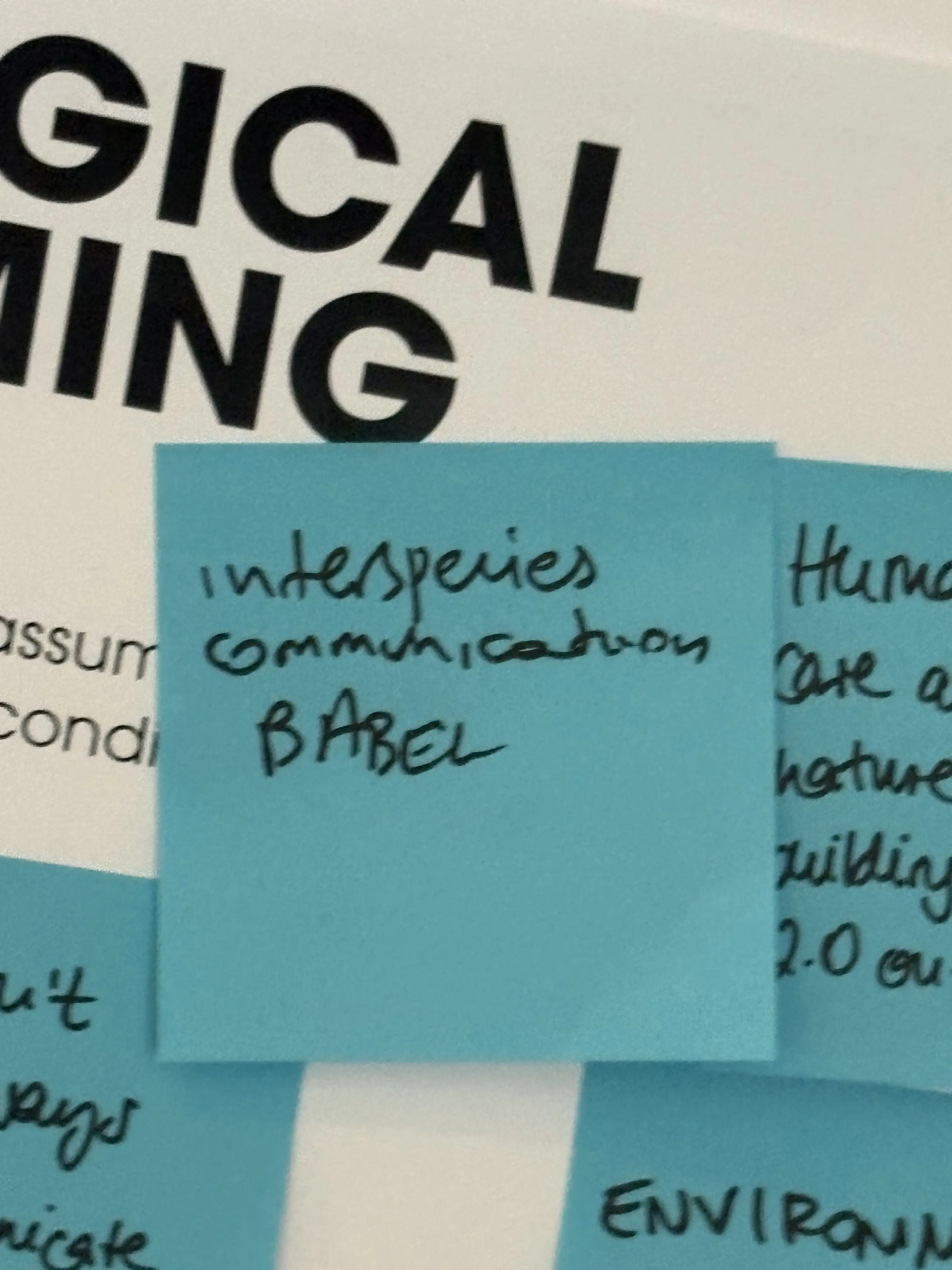
I sort of stopped caring why I rushed all the way out there in the first place. Why was I so obsessed with proving these maniacs wrong? The fact that the future remains so, no matter how hard they try, doesn't erase their effort. And who am I to judge, we’re all doing the same thing: believing in the power of our art projects.
And yet, as former Prime Minister Lee Hsien Loong of Singapore said, “Nothing we have today is natural or happened by itself. Somebody thought about it, made it happen.” Maybe I'm the one who is wrong – maybe belief is a virtue. Either way, I slipped out of the building before the talks were over to get some fresh air. The rain had cleared, and as I walked across the bridge, the air parted the clouds to the most beautiful fall day I had ever seen.